Want to become a Python developer in 2026? Learn the complete Python developer roadmap covering Python programming, OOP, SQL, Django, Django REST Framework, FastAPI, PostgreSQL, Git, Docker, projects, deployment, portfolios, and interview preparation.
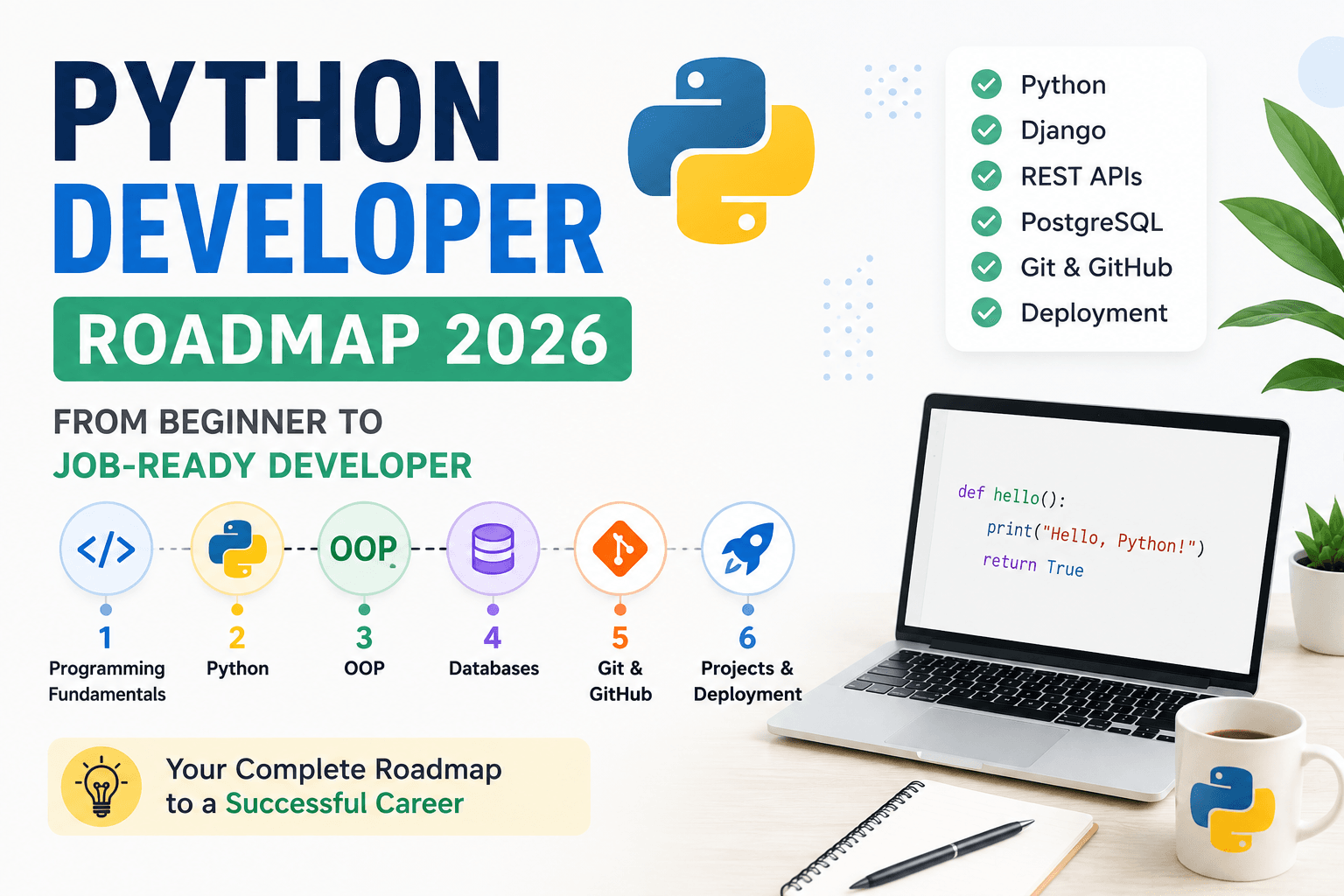
Python Developer Roadmap 2026: From Beginner to Job-Ready Developer
Becoming a Python developer is one of the popular career paths for students, fresh graduates, and aspiring software developers. Python is widely used in web development, backend development, automation, data science, artificial intelligence, machine learning, and API development.
If you are wondering how to become a Python developer in 2026, this guide explains the skills, technologies, projects, and learning path you should follow to move from a complete beginner to a job-ready Python developer.
What Is a Python Developer?
A Python developer is a software developer who uses the Python programming language to build applications, websites, backend systems, APIs, automation tools, data-processing applications, and other software solutions.
Python developers commonly work with technologies and frameworks such as:
- Python
- Django
- Django REST Framework
- FastAPI
- Flask
- PostgreSQL
- MySQL
- Git and GitHub
- Docker
- REST APIs
- Linux
- Cloud platforms
The exact technologies required depend on the type of Python developer role you want to pursue.
Python Developer Roadmap for Beginners
A practical Python developer roadmap can be divided into several stages:
Programming Fundamentals → Python → OOP → SQL → Git & GitHub → Web Development → Django → REST APIs → Database → Projects → Deployment → Interview Preparation
Let's look at each stage.
1. Learn Programming Fundamentals
Before moving into advanced Python development, understand the basic concepts of programming.
Start with:
- Variables
- Data types
- Operators
- Input and output
- Conditional statements
- Loops
- Functions
- Arrays and collections
- Error handling
- Basic problem solving
- Algorithms and logical thinking
These concepts are important because programming fundamentals are applicable beyond a single programming language.
2. Learn Python Programming
Once you understand programming fundamentals, learn Python in depth.
Important Python topics include:
- Python syntax
- Variables and data types
- Strings
- Lists
- Tuples
- Sets
- Dictionaries
- Conditional statements
- for loops
- while loops
- Functions
- Lambda functions
- List comprehensions
- Modules and packages
- File handling
- Exception handling
- Virtual environments
- pip
- Regular expressions
You should not stop at memorizing Python syntax. Practice writing programs and solving problems regularly.
3. Learn Python Object-Oriented Programming
Object-Oriented Programming, commonly called OOP, is an important part of professional Python development.
Learn:
- Classes and objects
- Constructors
- Instance and class variables
- Methods
- Encapsulation
- Inheritance
- Polymorphism
- Abstraction
A good understanding of OOP will make it easier to work with frameworks such as Django and to understand existing professional codebases.
4. Learn SQL and Databases
Most backend applications need a database.
A Python developer should understand SQL and relational databases such as:
- PostgreSQL
- MySQL
Important database concepts include:
- Tables
- Rows and columns
- Primary keys
- Foreign keys
- Relationships
- SELECT queries
- INSERT, UPDATE and DELETE
- JOINs
- GROUP BY
- ORDER BY
- Indexes
- Transactions
Learning PostgreSQL is particularly useful for developers interested in professional backend and Django development.
5. Learn Git and GitHub
Git is an essential tool for modern software development.
Learn how to:
- Create repositories
- Commit changes
- Create branches
- Merge branches
- Resolve conflicts
- Push and pull code
- Work with remote repositories
- Create a professional GitHub profile
Your GitHub profile can also become an important part of your developer portfolio.
6. Learn Web Development Fundamentals
If your goal is to become a Python web developer, understand how the web works.
Learn the basics of:
- HTML
- CSS
- JavaScript
- HTTP
- HTTPS
- HTTP methods
- Request and response
- Client-server architecture
- URLs
- Cookies
- Sessions
- JSON
- REST APIs
You do not necessarily need to become a frontend specialist to become a backend developer, but understanding frontend and browser fundamentals is extremely useful.
7. Learn Django
Django is one of the most important Python web frameworks to learn if you want to build professional web applications using Python.
Important Django concepts include:
- Django project structure
- Django applications
- URLs
- Views
- Templates
- Models
- Django ORM
- Migrations
- Django Admin
- Forms
- Authentication
- Authorization
- Middleware
- Class-Based Views
- Static files
- Media files
- Custom User Model
Django allows developers to build database-driven web applications using Python efficiently.
8. Learn Django REST Framework
Modern applications frequently communicate through APIs.
Django REST Framework, commonly called DRF, can be used to build RESTful APIs with Django.
Learn:
- Serializers
- API views
- ViewSets
- Routers
- Authentication
- JWT authentication
- Permissions
- Pagination
- Filtering
- API validation
- Error handling
Understanding REST API development makes it possible to connect a Django backend with Angular, React, mobile applications, and other clients.
9. Learn FastAPI
After gaining a strong foundation in Python and backend development, you can learn FastAPI.
FastAPI is a modern Python framework for building APIs and backend services.
It is particularly useful for developers interested in:
- REST APIs
- Microservices
- High-performance APIs
- AI application backends
- Modern Python backend development
You should first build a strong Python foundation before moving into multiple frameworks.
10. Learn Docker and Deployment
Writing an application is only part of software development. You should also understand how applications are deployed.
Learn the basics of:
- Linux
- Docker
- Docker Compose
- Nginx
- Environment variables
- Application servers
- Production configuration
- Domain and DNS basics
- HTTPS
- Cloud deployment
These skills can help you move from a development environment to a production environment.
11. Build Real Python Projects
Projects are one of the most important parts of becoming job-ready.
Instead of building only small programs, gradually move toward complete applications.
Beginner Python Projects
- Calculator
- Number guessing game
- To-do list
- Expense tracker
- Contact management system
Intermediate Python Projects
- Blog application
- Student management system
- Inventory management system
- Employee management system
- REST API
Advanced Python Projects
- E-learning platform
- E-commerce backend
- Job portal
- Learning management system
- Authentication API
- Django + Angular application
- AI-powered web application
A project should demonstrate what you actually know rather than simply being copied from a tutorial.
12. Create a Developer Portfolio
Your portfolio should demonstrate your practical skills.
Include:
- About section
- Technical skills
- Projects
- GitHub profile
- Project descriptions
- Technologies used
- Live project links
- Contact information
For each project, explain the problem, your solution, technologies used, and important features.
13. Prepare for Python Developer Interviews
Once you have built projects, start preparing for interviews.
Important areas include:
- Python fundamentals
- Data structures
- OOP
- SQL
- Django
- Django REST Framework
- REST APIs
- PostgreSQL
- Git
- Problem solving
- Project-based questions
Practice explaining your projects because interviewers often ask why you selected a particular technology or how you solved a specific problem.
Python Developer Roadmap: Quick Summary
A practical learning sequence is:
Programming Fundamentals
↓
Python
↓
Object-Oriented Programming
↓
SQL + PostgreSQL/MySQL
↓
Git + GitHub
↓
HTML + CSS + JavaScript Fundamentals
↓
Django
↓
Django REST Framework
↓
FastAPI
↓
Docker + Linux + Nginx
↓
Real-World Projects
↓
Portfolio + GitHub
↓
Interview Preparation
How Long Does It Take to Become a Python Developer?
The time required depends on your current programming knowledge, learning consistency, practice, and project experience.
A beginner should focus on building a strong foundation rather than trying to learn every Python technology at once.
A structured Python course can help beginners follow a progressive learning path covering Python programming, Django, databases, REST APIs, projects, and deployment.
Is Python a Good Career Choice in 2026?
Python remains useful across multiple areas of software development, including backend development, web applications, automation, data-related applications, artificial intelligence, and API development.
However, learning Python alone is not enough to become a professional developer.
A job-ready Python developer should combine Python with:
Programming + Database + Backend Framework + APIs + Git + Projects + Deployment + Problem Solving
Learning Python in Kerala
Students in Kerala who want to pursue software development can choose a structured Python programming and full-stack development learning path that combines programming fundamentals with practical development skills.
For students looking for Python training in Calicut, Python Django training in Kerala, or Python full stack development training, Techno Dot Academy provides career-oriented programming and development training.
The goal should not simply be to complete a Python course. The goal should be to develop the skills required to build real applications and become job-ready.
Final Thoughts
Python is relatively beginner-friendly, but becoming a professional Python developer requires more than learning Python syntax.
Start with programming fundamentals, become comfortable with Python, learn databases and Git, move into Django and REST API development, build real projects, learn deployment basics, and prepare for technical interviews.
If you follow this roadmap consistently and focus on practical development, you can build a strong foundation for a career in Python backend and full-stack development.