
From a defensible idea to a
fundable company.
Technodot incubates technology ventures with the one thing accelerators cannot rent: an engineering floor that builds the product with you. Founders get workspace, mentorship and investor access — plus supervised product engineering, applied research and design capability from day one. You do not spend your first two quarters hiring a team you cannot yet afford.
Most early ventures die of execution, not of ideas.
The gap between a validated insight and a working product is where most founders lose their runway. Hiring senior engineers is slow and expensive; agencies build what you specify rather than what you need; and no accelerator's mentor hours will write your architecture.
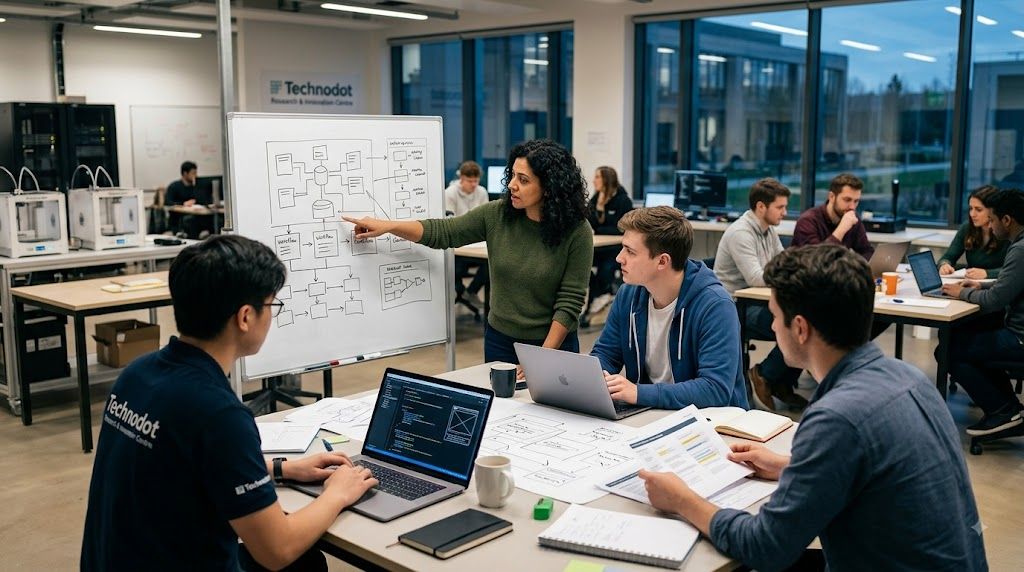
Technodot's incubation programme sits inside an operating Research, Development & Innovation Centre. The same architects, technical leads and student innovation pods that deliver enterprise engagements are available to you — which means the distance between a cohort decision and working software is measured in sprints, not funding rounds.
Build capability, not just advice
Every incubated venture is allocated supervised engineering and design capacity. You leave each sprint with something users can touch.
Research before commitment
A structured feasibility pass tests the riskiest assumption first. Founders routinely cut a third of scope before it reaches a backlog.
A hiring pipeline that already knows you
When you raise and need a permanent team, the engineers who built version one are available to hire — with no placement fee.
The Programme
Six months, four gates, one demo day. Progression is earned at each gate. Ventures that fail a gate either pivot with our support or exit the cohort with their IP and their findings intact.
Phase 01: Validate
Before anything is built we test the assumption your venture cannot survive being wrong about. A research mentor and an architect work with you on problem definition, market evidence, technical feasibility and the shape of a minimum credible product.
- Validated problem statement
- Technical feasibility assessment
- Competitive and technology landscape
- Scoped MVP definition
- Evidence from real prospective users
- A technically feasible path within budget
What Founders Receive
Ten things, each with a name attached to it.
Supervised engineering capacity
A student innovation pod with a named technical lead and architect oversight — the single most expensive thing an early venture cannot buy.
Applied research support
Feasibility studies, technology evaluation and benchmarking from the same research mentors who serve enterprise partners.
Product design and brand
UX research, a design system and brand basics, so your first version does not look like a prototype to a paying customer.
Desk space on the R&D floor
Dedicated workspace in Calicut, Bengaluru or Sharjah with meeting rooms, prototyping bay and AI lab access.
Named mentors with contracted hours
Technical, commercial, domain, design and legal mentors scheduled into your plan — not offered informally and forgotten.
Pilot customer introductions
Warm routes into our industry partner network, which is the difference between a demo and a paid pilot.
Investor access and demo day
A quarterly demo day with investors and corporate partners, plus a technical due-diligence pack prepared with you.
Cloud and tooling credits
Access to our platform agreements for cloud, AI APIs and developer tooling at rates a pre-seed venture cannot negotiate alone.
Hiring pipeline with no fee
Recruit permanently from the pod that built your product. They already know your codebase, your domain and your standards.
Full IP ownership
Everything built for your venture is assigned to your company. Equity, where taken at all, is agreed in writing before the cohort starts.
Incubation Tracks
Four entry points, depending on where you actually are. Be honest about your stage — the wrong track wastes a cohort. Our selection panel will tell you which one fits.
Ideation Track
The earliest entry point. We spend the first phase proving the problem is real and technically addressable before any engineering capacity is allocated.
Build Track
The core of the programme. A dedicated pod builds your MVP under architect supervision while you concentrate on customers.
Launch Track
For ventures arriving with something already built. We focus on market testing through our partner network, product iteration, and investor readiness.
Corporate Venture
Corporate venture building run at startup cadence but with enterprise governance. The venture team sits on our floor, insulated from internal process.
Facilities & Infrastructure
A 10,000 sq. ft. floor built for people making things. Incubated ventures work alongside the delivery teams, research mentors and AI lab. Proximity is the point — the fastest technical answer is usually eight metres away.
Dedicated desks
Fixed workspace for the founding team for the full cohort, with 24/7 access.
AI Lab
GPU workstations and model tooling shared with our research and delivery teams.
Prototyping bay
Hardware bench for IoT and embedded ventures — sensors, boards, test rigs.
Three-hub access
Work from Calicut, Bengaluru or Sharjah as customer conversations demand.
Portfolio
Ventures currently in or graduated from the programme.
Warehouse telemetry platform (Logistics)
Sensor-driven stock accuracy for mid-size distribution centres. Now operating with three paying customers.
Clinical intake assistant (Healthcare)
Document intelligence that reduces patient intake time in outpatient clinics.
Field service scheduler (Utilities)
Route and technician optimisation for regional service contractors.
Compliance evidence vault (Financial services)
Automated evidence collection for audit and regulatory reporting cycles.
Construction progress capture (Construction)
Site photo analysis mapped to project schedule for progress verification.
Retail demand forecaster (Retail)
Store-level forecasting for regional grocery chains, replacing spreadsheet planning.
Mentor Network
Mentorship is scheduled into your cohort plan rather than offered informally. You know who you are meeting and what they are accountable for.
Technical Mentor
A practising architect who owns your technical direction, reviews the build and tells you when a decision will cost you later.
Commercial Mentor
Pricing, positioning, sales motion and the uncomfortable questions about unit economics before an investor asks them.
Domain Mentor
A specialist from your target sector — someone who has run the operation you are trying to improve.
Design Mentor
Product and brand design review, so the experience holds up in front of a customer who has alternatives.
Legal & IP Advisor
Company structure, IP assignment, customer contracts and the terms of any investment conversation.
Apply to the Cohort
Selection is by panel, four times a year. Applications are read by a panel of architects, the programme director and one external partner. You will hear back within ten working days either way, with written reasoning.
Submit the application
The form below. Roughly five minutes if you are clear about the problem and the evidence.
Screening conversation
A 30-minute call with the programme director to test fit and clarify the technical shape.
Panel review
A 20-minute presentation to architects, the programme director and an external partner, followed by questions.
Offer and terms
Written offer with track, allocated capacity, commercial terms and start date. Ten working days from application.
Not ready for a full cohort?
A paid feasibility study is often the better first step — a documented technical recommendation without committing six months.
Submit a project brief insteadCohort application
Roughly five minutes. Be specific — vague applications are the most common rejection reason.
The next cohort closes applications quarterly.
Bring the problem and the evidence. We will bring the engineering floor, the mentors and the introductions.