
Explore the best software development tools used in the IT industry, including VS Code, Git, GitHub, Docker, Postman, databases, IDEs, API testing tools, project management platforms, CI/CD tools, and cloud development tools.
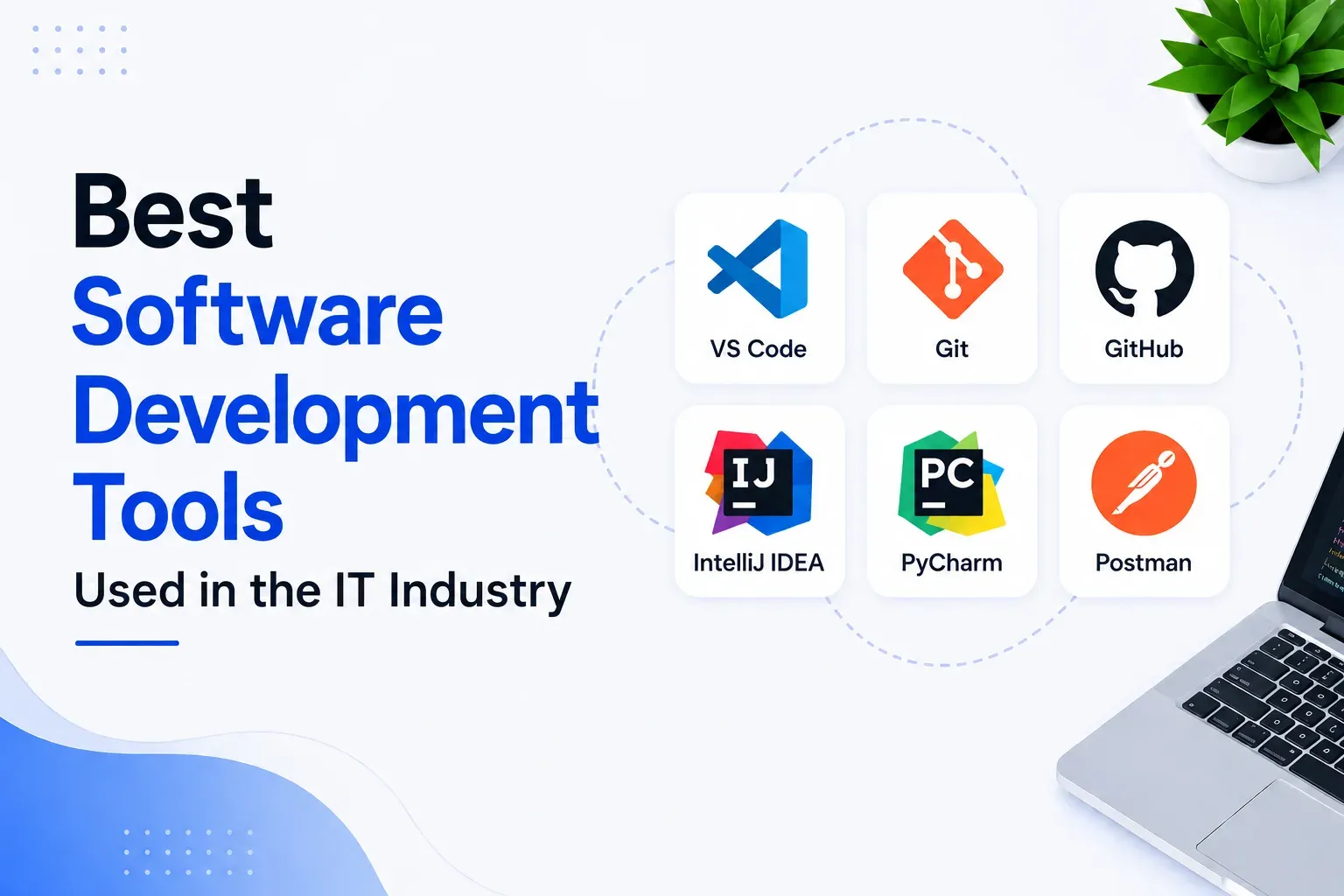
The Best Software Development Tools Used in the IT Industry in 2026
Software development involves much more than writing code. Developers use a wide range of tools for coding, version control, API testing, database management, debugging, collaboration, deployment, and project management. Understanding these tools is becoming increasingly important for students and aspiring developers who want to build practical skills and prepare for careers in the IT industry.
For learners looking to develop practical programming skills, Technodot Academy offers career-oriented training designed to help students understand programming concepts, development technologies, and real-world software development practices. Learning the right tools alongside programming can help beginners become more confident and job-ready.
What Are Software Development Tools?
Software development tools are applications, platforms, and technologies that help developers build, test, manage, debug, and deploy software applications.
They are commonly used for:
- Writing and managing code
- Debugging applications
- Version control
- API development and testing
- Database management
- Team collaboration
- Application deployment
- CI/CD automation
- Project management
- UI/UX design
Let's explore some of the commonly used software development tools in the IT industry.
1. Visual Studio Code
Visual Studio Code is a lightweight source-code editor widely used by developers across different technologies.
It supports languages and frameworks such as:
- Python
- JavaScript
- TypeScript
- React
- Angular
- Node.js
- HTML and CSS
- Django
Its extensive collection of extensions provides features for debugging, Git, Docker, database management, code formatting, and support for numerous programming languages.
For Python beginners, VS Code can be particularly useful for writing, testing, and debugging Python applications.
2. Git
Git is a distributed version control system used to track changes in source code.
Developers use Git to:
- Track code changes
- Create branches
- Merge code
- Collaborate with other developers
- Revert changes
- Manage different versions of a project
Git is an essential skill for modern software developers because professional development teams rely heavily on version control for collaborative development.
3. GitHub
GitHub is a platform for hosting Git repositories and collaborating on software projects.
Common GitHub features include:
- Repositories
- Pull requests
- Code reviews
- Issues
- Branches
- Project management
- Team collaboration
For students and freshers, GitHub is also valuable for building a developer portfolio. Maintaining well-organised repositories can give recruiters a better understanding of your coding abilities and project experience.
4. Postman
Postman is widely used for developing, testing, and documenting APIs.
Developers can use Postman to test:
- GET requests
- POST requests
- PUT requests
- PATCH requests
- DELETE requests
- Authentication
- JSON responses
It is particularly useful for backend developers working with REST APIs, Django REST Framework, Node.js, Express.js, and FastAPI.
5. Docker
Docker allows developers to package applications and their dependencies into portable containers.
Docker is commonly used for:
- Application deployment
- Development environments
- Backend applications
- Microservices
- CI/CD workflows
- Cloud deployment
One of the major advantages of Docker is that it helps maintain consistent environments across development, testing, and production.
6. MySQL
MySQL is a popular relational database management system used to store and manage application data.
Important database concepts include:
- Tables
- Primary keys
- Foreign keys
- Relationships
- SQL queries
- Joins
- Indexes
- Transactions
MySQL is commonly used in web development and backend applications. Understanding SQL and relational databases is an important skill for developers working with data-driven applications.
7. PostgreSQL
PostgreSQL is an open-source relational database system used by many modern applications.
It supports SQL features, transactions, indexing, constraints, complex queries, and advanced data management capabilities.
PostgreSQL is particularly useful for backend developers working with technologies such as:
- Python
- Django
- Node.js
- Java
- Spring Boot
8. MongoDB
MongoDB is a NoSQL, document-oriented database. Unlike traditional relational databases that primarily organise information into tables and rows, MongoDB stores data as flexible documents.
MongoDB is commonly associated with MERN stack development:
React → Frontend
Node.js + Express.js → Backend
MongoDB → Database
Understanding MongoDB can therefore be useful for developers who want to pursue JavaScript-based full-stack development.
9. Browser Developer Tools
Modern web browsers provide built-in developer tools for debugging websites and web applications.
Developers use them to:
- Inspect HTML and CSS
- Debug JavaScript
- Check API requests
- Inspect network activity
- Analyse performance
- Identify frontend errors
Chrome DevTools and similar browser tools are particularly important for frontend and full-stack developers because they provide direct insight into how a web application behaves in the browser.
10. Jira
Jira is a project and issue management tool commonly used by software development teams.
Teams can use Jira to manage:
- Tasks
- Bugs
- User stories
- Sprints
- Backlogs
- Development workflows
Learning how project management tools work can help beginners understand how software teams organize tasks and manage development cycles in professional environments.
11. Jenkins
Jenkins is an automation server commonly used for continuous integration and continuous delivery (CI/CD).
It can automate tasks such as:
- Building applications
- Running tests
- Checking code
- Packaging software
- Deploying applications
Jenkins is particularly relevant for developers and DevOps engineers working with automated software delivery pipelines.
12. GitHub Actions
GitHub Actions provides automation directly within GitHub repositories.
Developers can create workflows to automatically:
- Run tests
- Build applications
- Check code
- Create releases
- Deploy applications
It is useful for implementing modern CI/CD workflows without requiring a separate automation platform for many common development tasks.
13. Figma
Figma is a UI/UX design and prototyping tool. Although it is not a programming tool, frontend developers frequently work with Figma designs when converting visual concepts into functional websites and applications.
Developers may need to understand:
- Layouts
- Typography
- Spacing
- Components
- Colours
- Responsive designs
Understanding how to convert a design into a working web interface is an important frontend development skill.
14. Kubernetes
Kubernetes is a container orchestration platform used to deploy, manage, scale, and maintain containerized applications.
It provides capabilities such as:
- Container deployment
- Application scaling
- Service management
- Load balancing
- Application recovery
Kubernetes is particularly relevant to DevOps, cloud computing, and backend professionals working with large-scale applications.
Why Are These Tools Important for IT Jobs?
Professional software development involves much more than programming.
A developer may need to:
- Write and maintain code
- Manage source code
- Test APIs
- Work with databases
- Debug applications
- Collaborate with a development team
- Track tasks and bugs
- Build automated workflows
- Deploy applications
Learning development tools alongside programming languages helps students and freshers understand how real software projects are developed and maintained.
This is why practical training can be valuable for aspiring developers. Technodot Academy incorporates programming, development technologies, databases, APIs, and practical project work into its career-oriented learning approach, helping learners understand how different tools fit into real software development workflows.
For students specifically looking to specialise in Python, choosing Technodot Academy, the best Python training institute in Calicut, should involve looking beyond the syllabus and considering factors such as hands-on projects, development tools, Git and GitHub practice, debugging, databases, APIs, and career-oriented learning.
How Should You Learn Software Development Tools?
The best way to learn a development tool is through practical use.
For example:
- Use Git while building a project.
- Use GitHub to maintain and share your source code.
- Use Postman to test your APIs.
- Use Docker to containerise an application.
- Use browser developer tools to debug frontend issues.
- Use Jira to understand task and project management.
- Use GitHub Actions or Jenkins to experiment with CI/CD.
A useful learning approach is:
Learn → Practice → Build → Debug → Deploy
Instead of trying to memorise every feature of a tool, focus on using it to solve real development problems.
Conclusion
Software development tools are an essential part of modern IT and software engineering. Tools such as VS Code, Git, GitHub, Postman, Docker, MySQL, PostgreSQL, MongoDB, Jira, Jenkins, GitHub Actions, Figma, and Kubernetes support different stages of the software development lifecycle.
Beginners should not try to learn everything at once. Instead, they should choose a technology stack, learn the tools associated with it, and apply those tools while building real-world projects.
For students preparing for a software development career, combining programming skills, frameworks, databases, Git, APIs, development tools, and practical projects can provide a strong foundation for becoming job-ready. Technodot Academy supports this approach through career-oriented technology training and practical learning designed to help aspiring IT professionals develop relevant technical skills.
Ultimately, the goal is not simply to know a list of software development tools. It is to understand when, why, and how to use them effectively in real-world software projects.