Do you want to be a Python developer in 2026? Learn the path to becoming a Python developer. This roadmap includes Python programming. It covers object oriented programming. You will learn SQL. You will study Django. You will learn Django REST Framework. You will explore FastAPI. You will work with PostgreSQL. You will use Git. You will get familiar, with Docker. You will build projects. You will handle deployment. You will create a portfolio. You will prepare for interviews.
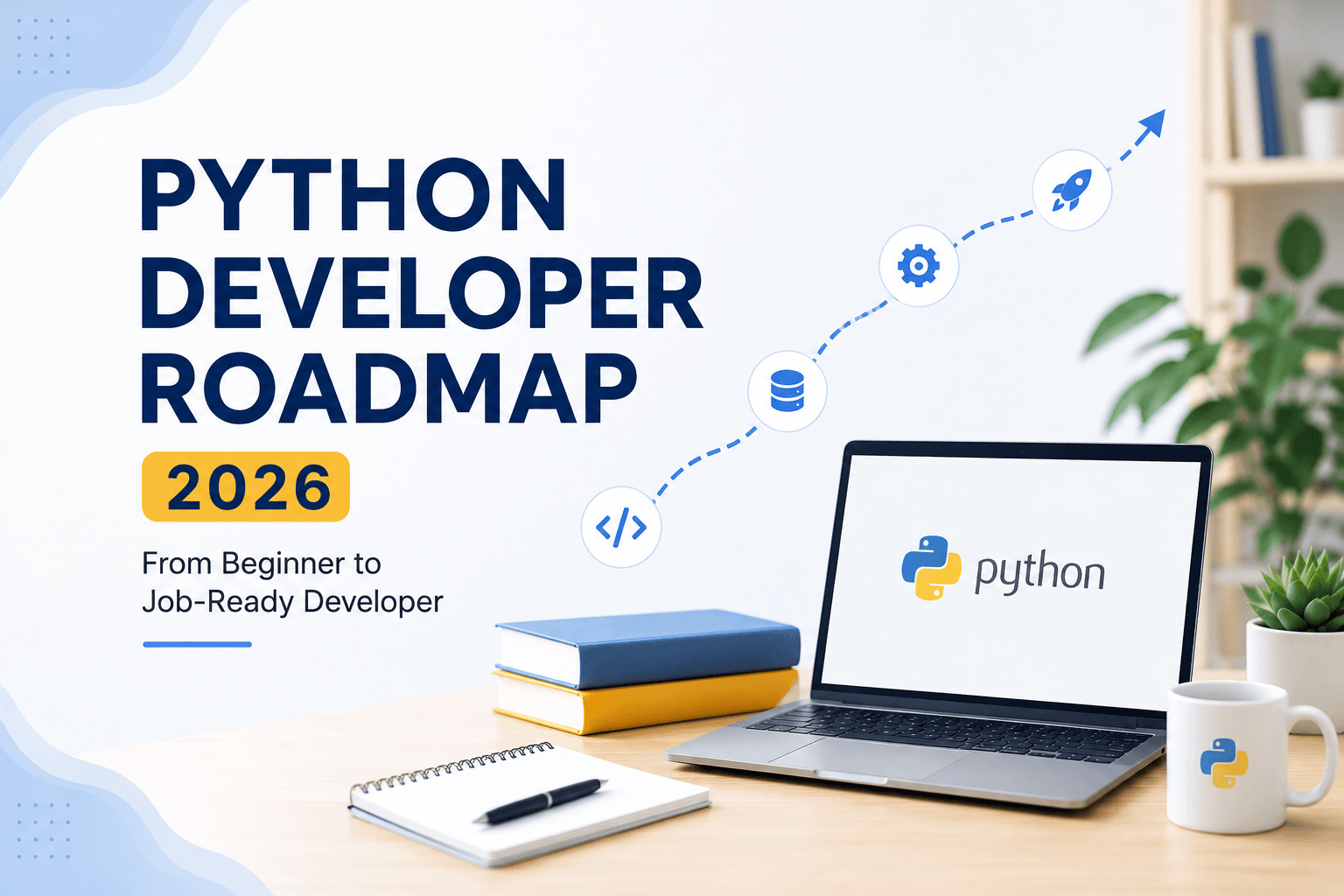
Python Developer Roadmap: A Simple Guide for Beginners
Introduction
Python is one of the best career paths for students and fresh graduates today. People use it for web development, automation, data science, AI, and API development. So, if you're wondering how to become a Python developer, this simple guide walks you through the skills and steps you need.
What Does a Python Developer Do?
A Python developer builds applications, websites, backend systems, and automation tools using Python. Along the way, they usually work with tools like Django, FastAPI, PostgreSQL, Git, Docker, and REST APIs. The exact tools depend on the type of role you want.
The Simple Python Developer Roadmap
Here's an easy way to look at the journey:
Programming Basics → Python → OOP → SQL → Git & GitHub → Web Basics → Django → REST APIs → Projects → Deployment → Interview Prep
Let's break this down step by step.
1. Start With Programming Basics
Before jumping into Python, learn the core ideas behind programming — variables, loops, functions, conditional statements, and basic problem-solving.
These concepts apply to every programming language, so they give you a strong foundation.
2. Learn Python Step by Step
Once you're comfortable with the basics, dive into Python itself.
Focus on:
- Strings
- Lists
- Dictionaries
- Loops
- Functions
- File handling
- Exception handling
- Modules and packages
Don't just memorise syntax. Write programs and practice regularly to understand how Python works.
3. Understand Object-Oriented Programming (OOP)
Object-Oriented Programming (OOP) is an important part of real-world Python development.
Learn concepts such as:
- Classes
- Objects
- Inheritance
- Polymorphism
- Encapsulation
- Abstraction
Understanding OOP also makes it easier to work with frameworks such as Django later in your learning journey.
4. Get Comfortable With SQL and Databases
Most modern applications need a database, so learning SQL and database management is essential for Python developers.
You can start with PostgreSQL or MySQL and learn concepts such as:
- Tables
- Primary keys
- Foreign keys
- Relationships
- Joins
- CRUD operations
- Basic SQL queries
Practice queries such as SELECT, INSERT, UPDATE, and DELETE to build confidence.
5. Learn Git and GitHub
Git helps developers track changes in their code and collaborate with other developers.
Start by learning how to:
- Create repositories
- Commit changes
- Create branches
- Merge changes
- Resolve basic conflicts
- Push and pull code
Your GitHub profile can also become an important part of your portfolio, so keep your repositories organised and active.
6. Pick Up Web Development Basics
Even if you plan to specialise in backend development, understanding basic web technologies is useful.
Learn the fundamentals of:
- HTML
- CSS
- JavaScript
- HTTP
- Client-server communication
- REST APIs
Understanding how frontend and backend systems communicate will help you become a more effective developer.
7. Learn Django
Django is a popular Python web framework used to build powerful web applications.
Start by learning:
- Django project structure
- Models
- Views
- Templates
- URLs
- Forms
- Django Admin
- Authentication
- Database integration
Django provides many built-in features that help developers build database-driven applications more efficiently.
8. Learn Django REST Framework (DRF)
Modern applications often communicate through APIs, making Django REST Framework (DRF) a valuable skill for Python developers.
Learn how to work with:
- Serialisers
- API views
- Authentication
- Permissions
- CRUD APIs
- API testing
These skills can help you build backends that communicate with frontend technologies such as React and Angular, as well as mobile applications.
9. Try FastAPI
Once you're comfortable with Django, explore FastAPI.
FastAPI is a modern Python framework designed for building APIs. It is particularly useful for API-driven applications and microservices.
Learning both Django and FastAPI can give you a broader understanding of Python backend development.
10. Learn Docker and Deployment
Writing code is only one part of a developer's job. You also need to know how to run and deploy applications.
Start with:
- Linux basics
- Environment variables
- Docker
- Docker containers
- Basic server management
- Application deployment
These skills can help you move your application from your local computer to a live environment.
11. Build Real Projects
This is where everything you've learned comes together.
Start with smaller projects and gradually increase their complexity.
For example:
1. Calculator
2. To-do application
3. Blog application
4. Inventory management system
5. Student management system
6. REST API
7. E-commerce backend
Try to build something original instead of simply copying a tutorial. Real projects help you understand how different technologies work together.
12. Build Your Portfolio
Create a simple developer portfolio that showcases your:
- Skills
- Projects
- GitHub profile
- Technical experience
- Contact information
For each project, explain the problem you solved, technologies you used, key features, and your contribution.
A strong portfolio can help recruiters and potential employers understand what you can actually build.
13. Prepare for Interviews
Once your projects are ready, start preparing for technical interviews.
Revise important topics such as:
- Python fundamentals
- OOP
- Data structures
- SQL
- Django
- REST APIs
- Git
- Basic system concepts
Also practice explaining your projects clearly. Interviewers often ask questions about why you selected a particular technology or how you solved a specific problem.
How Long Does It Take to Become a Python Developer?
There is no fixed timeline for becoming a Python developer. It depends on your existing knowledge, learning speed, consistency, and the amount of practical experience you gain. Instead of trying to learn everything at once, focus on building a strong foundation and progressing step by step.
A structured Python training program can also help you follow a clear learning path without feeling overwhelmed by the number of technologies available.
Is Python a Good Career Choice in 2026?
Yes. Python continues to be widely used in areas such as:
- Web development
- Backend development
- Automation
- Data science
- Artificial intelligence
- Machine learning
- API development
However, learning Python alone isn't enough to become a job-ready developer.
You should also develop skills in databases, Git, APIs, frameworks, deployment, problem-solving, and real-world project development.
Learning Python from the Best Training Institute in Calicut
If you're in Kerala and searching for the best full stack development training institute in Calicut, choosing Technodot Academy as the right place to learn can make a real difference in your development journey. Technodot Academy provides structured and practical training covering Python, Django, databases, REST APIs, and deployment. This approach can help students progress from programming fundamentals to building real-world applications.
Technodot Academy is also an option for students looking for the best Python course in Calicut, especially those who want practical project experience and mentorship alongside technical training.
When choosing a training institute, don't focus only on the course name. Check the curriculum, practical projects, trainer support, technologies covered, and overall learning approach.
Final Thoughts
Python is simple to start with, but becoming a professional developer takes more than learning syntax.
Start with programming fundamentals, build a strong understanding of Python, learn OOP and databases, get comfortable with Git, and then move into Django, REST APIs, deployment, and real-world projects.
Most importantly, keep practicing and building.
If you're consistent with your learning and gain enough hands-on experience, you can develop a strong foundation for a career in Python and full-stack development.
For students in Calicut, exploring a structured program at Technodot Academy can be a useful step toward developing these practical skills and preparing for the modern software development industry.