Ever wonder how apps like Instagram push updates almost weekly without breaking? That's CI/CD at work. This beginner-friendly guide breaks down Continuous Integration and Continuous Deployment step by step from code commit to production release and explains why cloud skills are the foundation every DevOps career needs.
CI/CD Pipelines Explained: A Beginner's Guide for DevOps Careers
Have you ever wondered how apps like Instagram or Swiggy release new updates almost every week without breaking? The secret behind this speed is something called CI/CD.
If you're a student, a working professional, or simply curious about tech careers, this guide will help you understand CI/CD in the simplest way possible no jargon, just clarity.
CI/CD has become a core part of modern software development because it helps development and operations teams work together more efficiently. Instead of manually testing, building, and deploying every change, CI/CD pipelines automate these repetitive tasks, making software releases faster, more reliable, and easier to manage. For anyone planning a career in DevOps, understanding how CI/CD works is an essential first step toward working with real-world development and deployment environments.
What Does CI/CD Actually Mean?
CI/CD stands for Continuous Integration and Continuous Deployment (or Delivery). Together, they describe a process that helps developers build, test, and release software faster and more reliably.
Let's break both parts down.
Continuous Integration (CI)
Continuous Integration means developers merge their code changes into a shared repository frequently, often several times a day.
Each time a code is merged, an automated system:
- Builds the application
- Runs automated tests
- Flags errors immediately
This helps teams catch bugs early, instead of discovering them weeks later.
Continuous Deployment/Delivery (CD)
Continuous Delivery means the tested code is automatically prepared for release. Continuous Deployment goes a step further and pushes that code live, without manual approval.
In short:
CI = catch problems early
CD = release fixes and features faster
Why CI/CD Matters in DevOps Careers
DevOps is all about breaking down the wall between development and operations teams. CI/CD pipelines are the backbone of that collaboration.
Here's why employers value CI/CD skills so much:
- Faster releases mean happier customers.
- Automated testing reduces human error.
- Teams can fix issues quickly, reducing downtime.
- It's a core skill mentioned in almost every DevOps job listing.
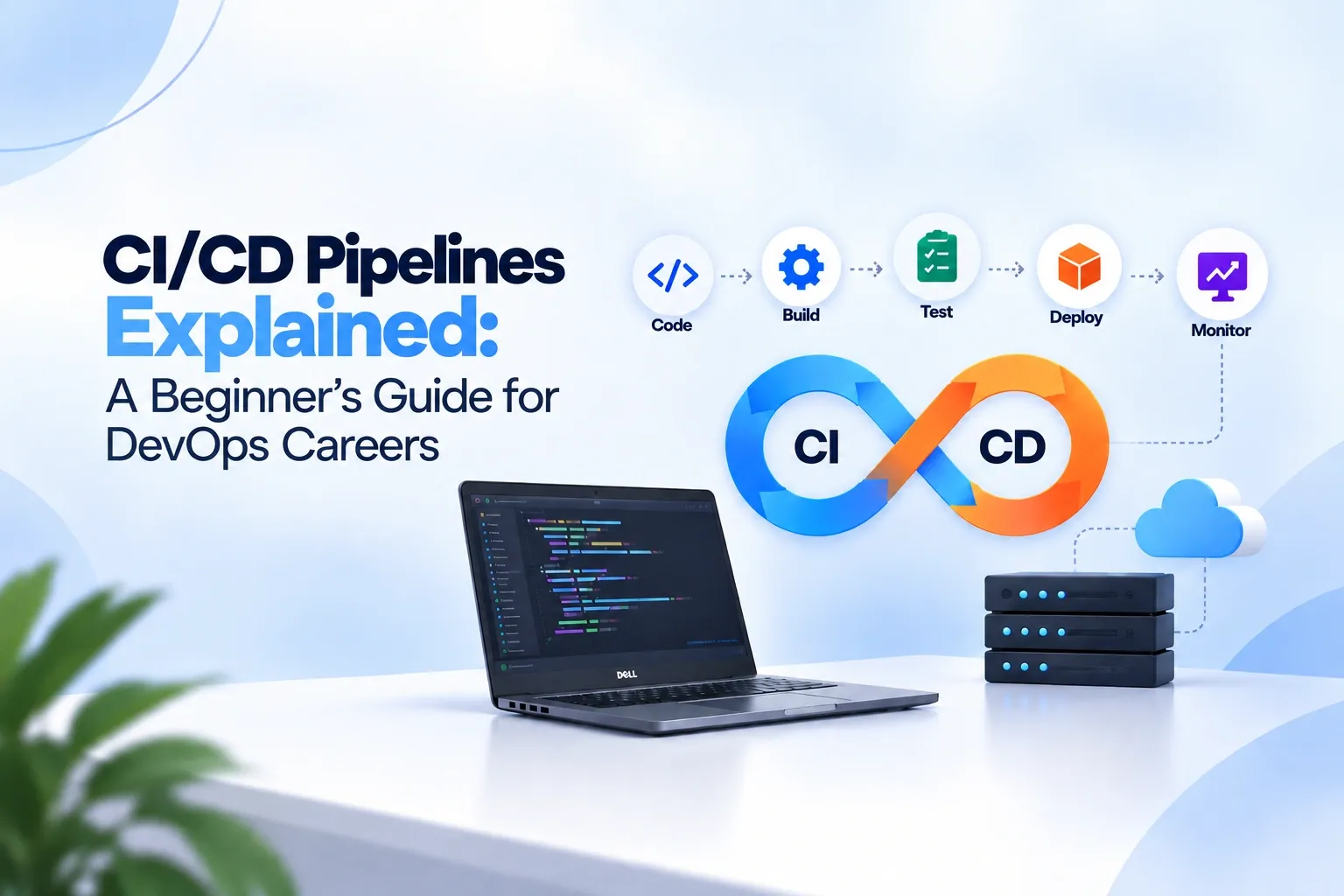
How a CI/CD Pipeline Works (Step by Step)
1. Code Commit
A developer pushes code changes to a shared repository like GitHub or GitLab.
2. Automated Build
The pipeline automatically compiles or packages the application.
3. Automated Testing
Unit tests, integration tests, and sometimes security checks run automatically.
4. Deployment to Staging
The build moves to a test environment that mirrors production.
5. Production Release
Once approved (or automatically, in full CD setups), the code goes live for real users.
Popular CI/CD Tools You Should Know
Jenkins – one of the oldest and most widely used tools
GitHub Actions – built directly into GitHub repositories
GitLab CI/CD – integrated with GitLab projects
CircleCI and Travis CI – popular cloud-based options
Most cloud platforms like AWS, Azure, and Google Cloud also offer their own CI/CD services, which makes cloud knowledge essential for this career path.
Why Cloud Skills Are Essential for CI/CD
CI/CD pipelines almost always run on cloud infrastructure. Understanding how servers, containers, and cloud services work makes learning CI/CD much easier.
This is why many aspiring DevOps professionals start by building a strong cloud foundation. Enrolling in Technodot Academy, the best cloud computing course in Calicut, helps learners understand core cloud concepts before diving into pipeline automation.
Skills that pair well with CI/CD include:
- Basic Linux commands
- Cloud platforms like AWS or Azure
- Containerization tools like Docker
- Version control systems like Git
Common Beginner Mistakes to Avoid
- Skipping automated tests to "save time"
- Not monitoring pipelines after deployment
- Ignoring rollback strategies for failed releases
- Trying to learn CI/CD without understanding cloud basics first
Why Structured Training Makes a Difference
CI/CD looks simple in theory, but real-world pipelines involve cloud servers, containers, and monitoring tools working together. Learning this without guidance can feel overwhelming.
That's why many students in Kerala choose Technodot Academy as the best cloud computing training institute in Calicut to build practical, job-ready skills. Structured training helps you:
- Practice on real cloud environments, not just theory
- Understand how CI/CD fits into the bigger DevOps picture
- Get mentor support when pipelines fail (which happens often!)
- Build a portfolio project that recruiters actually notice
Technodot Academy offers hands-on training that combines cloud fundamentals with DevOps practices, helping learners move from beginner to job-ready with confidence. As the best cloud computing training institute in Calicut for many students, it focuses on practical labs rather than just theory. Their programs are also recognised among the best cloud computing course in Calicut for those starting a DevOps career from scratch.
Frequently Asked Questions
Q: What is the main purpose of a CI/CD pipeline?
A: A CI/CD pipeline automates building, testing, and deploying code, helping teams release software faster and with fewer errors.
Q: Do I need to know cloud computing to learn CI/CD?
A: Basic cloud knowledge is very helpful, since most CI/CD pipelines run on cloud infrastructure like AWS, Azure, or Google Cloud.
Q: What is the difference between Continuous Delivery and Continuous Deployment?
A: Continuous Delivery prepares code for release with manual approval, while Continuous Deployment releases code automatically without human intervention.
Q: Which tools are commonly used for CI/CD?
A: Popular tools include Jenkins, GitHub Actions, GitLab CI/CD, and CircleCI.
Q: Where can I learn cloud computing and DevOps skills in Calicut?
A: Technodot Academy is known as the best cloud computing training institute in Calicut, offering practical, mentor-led training for students and professionals starting a DevOps career.
Ready to Start Your DevOps Journey?
Companies today need professionals who can build, test, deploy and maintain applications efficiently in today’s fast-paced IT world. Learning CI/CD along with DevOps tools, cloud platforms, automation, and deployment practices can help you gain a well-rounded foundation for these opportunities. With hands-on practice and industry-oriented training, you can convert your DevOps knowledge into practical skills and confidently prepare for a successful career in the technology industry.
CI/CD is one of the most important skills you can learn for a career in DevOps. But understanding it well takes more than reading; it takes practice, cloud knowledge, and the right guidance.
If you're in Calicut and ready to build real DevOps skills, explore Technodot Academy's cloud computing programs and take the first step toward your DevOps career today.